Tag: Writing

Idioms

LI: To identify idioms and understand their figurative meaning.

For writing, we learned about what is an idiom, learning objectives, literal and figurative, the purpose of idioms and how to create an idiom. We were challenged to create an idiom by picking an object (animal, food or weather), an action (unusual, funny, something happening to the object) an example is, the monkey is slipping on the ice and giving it a meaning (decide what the idiom will mean and to make it different from literal words). One of the idioms we went through was cool as a cucumber which means very calm; not nervous. An idiom is a phrase or expression where the meaning isn;t obvious from the individual words. We enjoyed doing this because we are putting words together to make our own idiom. One interesting fact is that they are often specific and difficult to translate or know.

What are Idioms?

Idioms are expressions or phrases that have a figurative meaning different from their literal meaning. They are often culturally specific and convey an idea or sentiment in a way that can be more impactful or colourful than straightforward language. For example, saying someone “kicked the bucket” is an idiom meaning they died, rather than referring to the literal action of kicking a bucket. Idioms are commonly used in everyday speech and writing to add flavour and convey meanings efficiently.

Mt. Fuji / Volcano Poem

LI: To write a multi verse cinquain poem that describes the journey of a sleeping maunga that erupts.

We have been exploring cinquain poems. A conquain poem. A cinquain poem has 5 lines. Each line has a different purpose. Line 1 is a noun which is a name. Line 2 has 2 adjectives that describe the noun. Line 3 has 3 verbs that end in ‘ing’ and describe the actions. Line 4 is a noun phrase which is a group of words (not a sentence) that go together to describe the noun. Line 5 is a synonym which is a word with a similar meaning to the noun. We used our poem to show our understanding of volcanoes.


Why Maungarei Sleeps? A pourquoi story

Long ago, in a distant land across the sea, there was a mountain called Maungarei. Fierce yet protective, Maungarei was known not just for her eruptions, but for the powerful spirit that resided within her. The people living nearby revered her as “The Guardian of Ashes.” Those who chose to settle close to her felt a mix of fear and admiration as they acknowledged her dual nature. The village at the foot of Maungarei was once vibrant and thriving, filled with families, laughter, and the hustle and bustle of daily life. Farmers tended to their fields, their crops flourishing beneath the sun, and children played in the meadows, blissfully unaware of the power that loomed above.

The villagers held a deep reverence for the mountain, believing that she was a goddess—both a fierce protector and a formidable force. In their folklore, tales of her might were preached in hushed whispers around the fire, recounting past eruptions that had reshaped the land but also shielded them from greater threats beyond the mountain. As time went on, Maungarei’s presence grew even more significant. 

The ground would tremble softly beneath the villagers’ feet, a gentle reminder of her vigilance. Occasional bursts of steam and smoke would rise from her peak, casting shifting shadows over the valley. Elders in the village urged caution, sharing stories of how Maungarei had safeguarded them from dangers, while also warning that nature’s fury should never be underestimated. Though the villagers wished for calm, they understood that her outbursts were part of her protective nature.

Daring souls ventured up the slopes of Maungarei, curious about the mysteries she held. The view from her summit was breathtaking, revealing wide expanses of verdant land and sparkling waters below. Those who ascended often returned with tales of awe—a sudden chill in the air, the rumble of the earth, and a feeling of being watched over by a benevolent presence. It was a profound and humbling experience; many came to see Maungarei not merely as a mountain, but as a guardian spirit that demanded respect and reverence.

In their desire to honor her, the villagers created rituals to show gratitude, offering gifts of flowers, fruits, and vibrant textiles, hoping to forge a stronger bond with the mountain. They gathered in the square, their voices raised in song, their prayers echoing into the cool mountain air. Yet, no matter their efforts, Maungarei remained unpredictable. Her mood shifted like the seasons, reminding them that while she watched over them, she was also capable of great fury.

One fateful night, under a sky thick with clouds, the ground shook violently, and a roar echoed like a thousand thunderclaps. Maungarei erupted, spewing ash and glowing lava into the night sky. The villagers scrambled for safety, their hearts pounding as they tried to flee the impending doom. Despite their efforts, many were caught in the chaos, their homes buried beneath mountains of debris.

In the aftermath of the eruption, as dawn broke over the ash-covered landscape, the villagers stood in silence. They were broken people, mourning their losses while recognizing the resilience within them. As they picked through the rubble, they discovered the paths of safety that Maungarei had created, guiding them away from devastation. From the destruction came an opportunity to rebuild and start anew, forging a deeper connection with the mountain. Maungarei, once solely seen as the source of their torment, had forever transformed into a guardian spirit—an entity that reminded them of their fragility and strength while continuously watching over them as they journeyed onward.

Maungarei stands as a formidable guardian, a towering sentinel embodying the very essence of power and protection over the land and its people. This majestic volcanic mountain commands reverence, its imposing presence a symbol of strength, resilience, and unwavering guardianship. 

As a watchful protector, Maungarei instills a profound sense of security in the communities nestled at its feet, fiercely safeguarding their heritage and way of life. It looms in grandeur, a timeless reminder of nature’s raw power, urging respect and reverence for the delicate balance of the ecosystem it oversees.

In moments of upheaval and uncertainty, Maungarei becomes a beacon of strength, inspiring its people to rise against adversity and fostering a spirit of unity and resilience. Its deep roots connect the past with the present, igniting a sense of purpose and responsibility among those who dwell in its shadow. Maungarei is not merely a mountain; it is a powerful embodiment of nature’s majesty and a steadfast guardian, guiding its people with unwavering resolve through life’s challenges.

Once, the mighty volcano was filled with passion and energy, frequently erupting with vibrant flames and smoke. However, this constant activity began to wear on the surrounding landscape, creating chaos among the animals and plants that depended on a stable environment. 

The problem was resolved when a wise old tohunga, known for their deep understanding of the balance in nature, approached the volcano. Sensing the unrest and the toll it was taking on its surroundings, the tohunga gathered the other mountains and the creatures of the land to share their observations and wisdom.

In a moment of introspection, the volcano realized that its fierce nature, while powerful, was causing fear and destruction. The tohunga’s gentle guidance helped the volcano understand that to bring harmony back to the land, it must learn to embrace rest rather than constant activity.

The wise old tohunga played a vital role in teaching the volcano about balance and the importance of rest. Through stories and rituals, the tohunga illustrated how even the mightiest can benefit from moments of stillness, highlighting that rest is essential for renewal.

In addition to the tohunga’s wisdom, a clever animal—a raven who often perched atop the peak—also contributed. The raven shared tales from its travels, describing places where mountains had learned to rest, allowing the world around them to flourish. This combination of guidance inspired the volcano to reconsider its approach.

Through contemplation and the teachings of the tohunga and the wise raven, the volcano began to practice being dormant. It started by choosing moments of stillness, reducing its fiery displays, and focusing on the calming energy within. The mountains around it encouraged this behavior, reminding the volcano that stillness could be powerful in its own right.

The volcano changed its behavior by embracing patience and serenity. Instead of constantly seeking out eruptions, it allowed itself to pause and reflect. The once-frequent eruptions grew less frequent, and the lava flows slowed, creating a serene craterscape covered in lush vegetation. As the volcano learned to sleep, the air around it became clearer, and life thrived in the newfound peace, showcasing the beauty of balance between activity and rest.

After the volcano started to sleep, the landscape transformed from chaos to calm. The air cleared, allowing sunlight to shine through, and the sounds of eruptions were replaced by the soothing rustle of leaves and bird calls. Rivers, once blocked by volcanic debris, began to flow freely, fostering new vegetation.

As the environment stabilized, communities found opportunities for rebuilding. Ecotourism flourished, attracting visitors eager to see the recovering area. Farmers returned to their fields, benefiting from the nutrient-rich soil, which enhanced crop growth. The local economy began to stabilize as businesses shifted focus to sustainability.

Overall, the world emerged with a renewed sense of hope. People came together, united by their experiences, and committed to protecting the environment while embracing a more sustainable way of life. The scars of the past gradually healed, paving the way for a brighter future.

In the stillness of her sleep, Maungarei held the promise of new beginnings—the knowledge that even the quietest mountains harbour immense power, and that is why Maungarei sleeps, patiently watching over her land, waiting for the right moment to awaken once more.

For this activity, we were challenged to make a Pourquoi Story explaining Why Maungarei Sleeps. A pourquoi story is a type of folktale that explains why something exists or happens. It often involves supernatural or mythical elements and provides a cultural or mythological explanation for natural phenomena, human customs, or other aspects of the world. I have used Adobe Express to generate a volcano using the prompts.


Diary of ANZAC Soldier

LI: To retell an event in history through the fictional eyes of someone who was there.

We have been looking at some different stories that took place at the ANZAC Cove on April 25 1915, during WW1. Many of our New Zealand’s soldiers were wounded or killed during the war. We looked at videos and pictures of the life in the trenches. We also explored the Walking with ANZACs site and read Hami Grace’s diary. This helped us put our own diary together. We used Google Vids to record our diary that we wrote using the information we learned about WW1. I enjoyed using this as it allowed me to build confidence while reading my diary infront of the camera. Something I found interesting about the Soldiers in WW1 is that some of them had a diary in their left pocket, which made them survive the shot that was fired by the allies. 

Time Traveller’s Podcast ft Samuel Marsden


In Literacy, we used our Inquiry knowledge to craft thoughtful questions we might have asked Reverend Samuel Marsden if we had the opportunity to meet him in person. This activity was especially enjoyable because we took on the roles of Samuel Marsden and the Time Traveller’s Podcast team, which made the experience feel like a real-life interview with him.

We learned that when you are recording a podcast expression is everything! It makes what we have to say more appealing.

Photo Story

LI: To understand the concept of visual storytelling

Panmure Bridge went for a walk to Pt England Reserve, The reason we went there was to gain knowledge about Samuel Marsden and what he saw while coming down the Tamaki Awa. On the walk LS1 joined LS2 on the walkway. When we reached our destination we had a quick break and ate our morning tea followed by a short play before returning back to school. I really enjoyed this walk because we got the opportunity to learn more about Samuel Marsden.

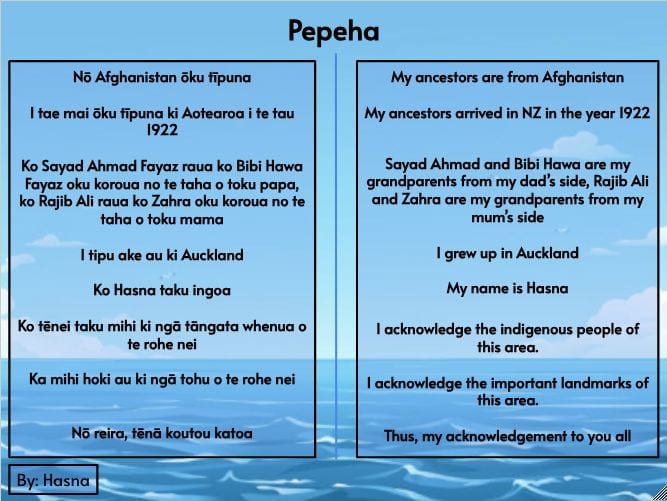
Pepeha

LI: To let others know who I am so they can make connections to me and my place in the world.

Our challenge today was to write and record our pepeha to introduce ourselves. I found this activity enjoyable because I got the opportunity to ask my parents where my ancestors are for, and who is our grandparents. I really enjoyed representing the Maori Culture and where your from making you feel proud of where you come from too. No reira tena koutou katoa. Thus my acknowledgment to you all. Thank you for reading to my Pepeha.

Exploring AI in Writing

LS2 explored PapyrusAI to help us craft a narrative. PapyrusAI is a generative AI tool that aids in creating, predicting word patterns and uses a LLM (Large Language Model). It’s important to verify the information it generates, as it may only sometimes be correct. We combined two fairy tales, Little Red and Snow White together and followed the prompts to write our narratives. I enjoyed using Papyrus AI because it gave me some suggestions to make my story better.

Through the Forest: A Day with Snow White and Little Red Riding Hood

In a faraway kingdom, there lived a kind-hearted princess named Snow White. She was admired for her gentle nature and striking beauty, which shone brighter than the sunlight streaming through the castle windows. Her father had remarried a cruel woman, now the queen, whose heart was as cold as the stone walls surrounding her. This queen, obsessed with being the most beautiful, cared for nothing but her own reflection in her enchanted mirror.

Every day, her jealousy grew, like twisted vines creeping up an old tower. One morning, after the mirror declared Snow White “the fairest of them all,” the queen’s rage boiled over. She summoned a guard to take young Snow White deep into the dark, whispering forests and kill her. However, upon seeing Snow White’s innocence and grace, the guard’s heart softened. Instead of harming her, he spared her life and, in the forest’s shadows, told her to run. In a cunning deceit, he offered the queen the heart of a wild pig, claiming it was Snow White’s.

Meanwhile, unbeknownst to the queen, Snow White found refuge with seven curious dwarfs, whose small stature belied their kind and protective nature. While venturing through the woods, Snow White saw Little Red Riding Hood being approached by a big evil wolf. Acting quickly, Snow White grabbed Little Red Riding Hood and ran with her. The big evil wolf chased after them but then tripped on a rock and fell unconscious.

Snow White and Little Red Riding Hood ran into the small cottage of the seven dwarfs and stayed there. The dwarfs looked at Snow White and Little Red and said, “Oh dear, what happened? You girls look terrified.” Snow White looked at the dwarfs and exclaimed, “WE ARE GETTING CHASED BY A BIG EVIL WOLF, PLEASE LET US STAY HERE.” The dwarfs said, “You can stay here, but we have to go mining. Do NOT let anyone inside.” Little Red responded confidently, “You can count on us.” The dwarfs grabbed their mining tools and left the cottage. Snow White, barely awake, soon fell asleep. Then, Snow White’s evil stepmother, disguised, knocked on the door saying, “Would you like some fresh apples?” Little Red replied, “Yes, please!” She took an apple and ate it. Snow White awoke to find Little Red pale and unconscious. A few hours later, the dwarfs returned and found Little Red on the floor. Overcome with concern, they held Little Red’s body and gently carried her into a glass box.

2 words 2 minutes

Today we used the ‘2 words 2 minute’ challenge to write a description about the ancient olympics. Before I tell you what we did, I will explain the 3 rules. 1. Don’t stress just guess, 2. Write as fast as you can and the 3rd rule is Make sure it makes sense. We first talked in pairs about the things we knew about the ancient olympic. We chose the words ‘Greece’ and ‘athletes’ to help us think about what we were going to write. After we thought about it, Someone started the timer and it was our turn to write what we knew about the ancient olympic. The timer was up and we readed to our pairs what we wrote. After that we missed a line under our story, then we wrote PLI which means Personal Learning Intention, I needed to focus on my compound sentence and my complex sentence. I had fun with this activity because it made me think what I should write and I also had 3 rules to remember while writing my story/sentence about the ancient olympic.

Rewrite Challenge

LS2 was challenged to rewrite a sentence without using certain letters, as well as keeping the same meaning. Thanks to WordHippo, which it’s a website that helps us discover a new different word. We were given 3 texts to rewrite and each text got really hard with certain letters that we couldn’t use. For example: We had to rewrite the text of “Humpty Dumpty” and the letters we couldn’t use were “A, L and K”. If you want to see our text, take a look at the next slide! 

I found this activity challenging yet helpful because the words we used could be added into our vocabulary list!