Tag: Reading

Waltzing Matilda

LI : to understand the story behind the poem

In our Reading class, we delved into the poem/song “Waltzing Matilda,” which holds a significant place in Australian culture. The poem tells the story of a swagman—an itinerant worker—who travels through the countryside, living a transient lifestyle. As he sets up camp by a billabong, he encounters a sheep and subsequently steals it to satisfy his hunger. The poignant refrain, “You’ll come a Waltzing Matilda with me,” recurs at the end of each stanza, inviting listeners to join the swagman on his journey.

“Waltzing Matilda” was written by Banjo Paterson in 1895 and has since become one of Australia’s unofficial national anthems. The term “waltzing Matilda” itself refers to the act of carrying one’s belongings rolled up in a blanket or tarpaulin, which is a common practice among swagmen. The swagman’s fate takes a tragic turn when he is pursued by the authorities for the theft, leading to his demise by jumping into the billabong.

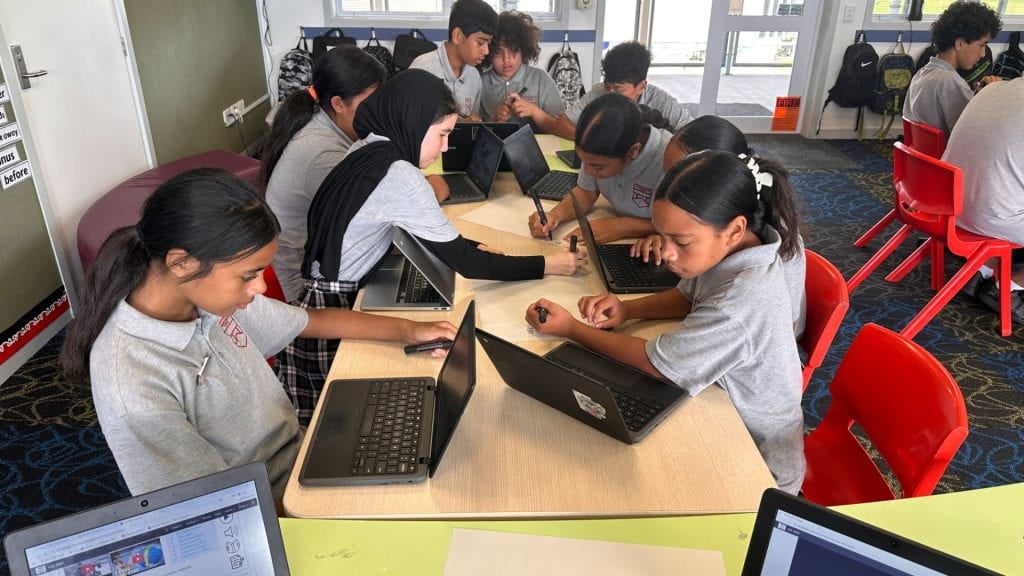
After reading and discussing the poem, we engaged in an analysis where we responded to questions using our own words and interpretations. We were then challenged to create a Digital Learning Object (DLO) that reflected our understanding and analysis of the poem, all while summarising it in exactly 25 words. This activity was not only enjoyable but also deeply enriching, as it allowed us to learn about the historical context of swagmen and gain a greater appreciation for the narrative woven through “Waltzing Matilda.” Exploring this iconic piece of literature gave us insights into Australia’s cultural heritage and storytelling traditions.

Group 2a – The Great Shearers Strike

LI: to understand the story of the poem

For reading, we were challenged to create a DLO explaining both perspectives about the Great Shearers Strike. We watched 2 videos that told us about the Strike in Australia (the strike was inspired by future labour reforms and the birth of Australian Labour Party. We shared our knowledge to explain what we know from the video that is added to our perspective A and B (Farmers and Shearers). Did you know that the farmers were paying the shearers low money which led to the shearers to protest and show them what is not enough on the other side Shearers needed a day off due to showing their bosses about how they do things, treat others and how they were getting low paid money. In our own opinion it talks about which side is the best decision. We wrote a summary about the story of the Great Shearers Strike. We enjoyed learning about The Great Shearers Strike because we got to learn about how strike was invented and how they fought for their own rights.

Malala Yousafzai Poster

LI: To analyse how Malala uses her personal story and persuasive language to achieve her purpose.

For reading, we were challenged to design a poster promoting one of Malala’s key messages (e.g., ‘Education is the only solution,’ ‘The pen is mightier than the sword,’ ‘One child, one teacher, one book, and one pen can change the world’). Me and Amorangi decided to collaborate with each other and together we created a poster about all the quotes that Malala Yousafzai mentioned in her speech. We had the decision to create a poster from Canva or Adobe Express, We chose Canva. Here is some of the information that I know about Malala from my research about her.

Malala Yousafzai became an international symbol of the fight for girls’ education. She was born in Mingora, Pakistan on July 12, 1997. Malala rose to global prominence after surviving an assassination attempt by the Taliban in 2012. She has become a symbol of resilience, courage, and the worldwide fight for girls’ education. Malala’s advocacy for girls’ education and her unwavering commitment to the cause have inspired millions globally. Her remarkable journey and determination have made her a leading figure in the ongoing struggle for equal access to education for all children, regardless of gender.

A Taliban gunman shot Malala Yousafzai on October 9, 2012, as she rode home on a bus after taking an exam in Pakistan’s Swat Valley. The Taliban targeted her because of her outspoken support for girls’ education, to which they objected. Malala’s courage and determination to speak out on behalf of the rights of girls to receive an education made her a target for extremists who sought to silence her powerful voice.


RISE UP: The Story of the Dawn Raids and the Polynesian Panthers

LI: To evaluate (form an opinion) the text and respond to the provocation.

For reading, Group 2 read a text called RISE UP: The Story of the Dawn Raids and the Polynesian Panthers. We were challenged to create a DLO that explores and discusses both perspectives of this historical event in our groups. We used our smart searching skills to learn and find stuff about the dawn raids, which lead us to talk about the danw raids. For our own opinion , we said that we think the dawn raids was a very discriminal and shameful event that occured in New Zealand. Something I found interesting about this text was that alot of policies had targeted pacific people just because they don’t belong in this country.


Once a Panther

LI: To identify the key historical context and events related to the Polynesian Panthers and the Dawn Raids as depicted in the graphic novel.

Group 2 read the text Once a Panther and asked to create a comic strip that depicts a scene related to the ideas of prejudice, justice, or taking a stand in today’s world using thought bubbles or dialogue that explains the image.
In this comic strip I chose to relate to the idea “taking a stand in today’s world”.

Something I found interesting about this challenge was that this comic strip I made was inspired about the RISE UP: The Story of the Dawn Raids and the Polynesian Panthers.

‘Shameful stain on NZ history’: Polynesian Panthers push for dawn raids apology

LI: To evaluate (form an opinion) the text and respond to the provocation

We ready the text ‘Shameful stain on NZ history’: Polynesian Panthers push for dawn raids apology

For this activity, we was challenged to create a DLO showing both sides and our own opinion. For Perspective A, I wrote the government of today should offer an apology for the dawn raids of the 1970s as a crucial step towards acknowledging past injustices and fostering reconciliation. These raids, which targeted Māori and Pacific Islander communities in the name of immigration enforcement, were marked by intimidation and discrimination, violating the basic human rights of individuals and families. For Perspective B, The government shouldn’t apologize because the government from today (2021) wasn’t the person who arranged the dawn raides, it was organized by the government back in 1970. So I think they shouldn’t be the one to apologize because it wasn’t their fault. One other reason I think they shouldn’t apologize because the one in power today (2021) wasn’t responsible for organizing the dawn raids; that decision was made by the government back in 1970. Therefore, it seems unfair to hold the current administration accountable for actions taken by a previous government. They shouldn’t have to bear the blame for something that wasn’t their fault.

In my opinion, the government should issue an apology for the impact it has had on the health of Pacific communities. The actions taken have not only harmed individuals but have also resulted in generational trauma that continues to affect these communities today. Acknowledging this harm is an important step towards healing and rebuilding trust between the government and the people it serves. 

I enjoyed this activity because it gave me the opportunity to collaborate with other.

Mapping the Migratory Flight of the Kuaka

LI: To use Google My Maps to show the migratory flight path of the Kuaka.

For this activity we needed to create a map that shows how long the kuaka birds fly for and where the kuaka birds migrate to.  

Kuaka birds, also known as bar-tailed godwits, love to hang out near the water, especially in places like estuaries, mudflats, beaches, and coastal marshes, where they find lots of yummy food.

Every year, as winter approaches, the Kuaka fly north to the breeding grounds of Alaska, stopping off in Korea and Japan for a rest and some food on the way. On the return journey, as our summer approaches, they fly directly to New Zealand, a trip of endurance with no food, water, or rest; nearly 12,000 km non-stop.

Dot to Dot Connections: The Kuaka

LI: To draw the lines between the words to show how the connections you have made.

For this activity, we created a DLO showing our Dot to Dot Connections of the Kuaka Bird. We used the scribble tool to connect each word and write down information that is related to the text. For example : Migration and Habitat (The Kuaka birds migrate from Alaska to NZ to have a safe environment). We used our prior knowledge to figure out some information about the Kuaka Bird. Something we enjoyed while doing this activity was collaborating and communicating to each other to grab different ideas and learn from one another.

The Kuaka

LI: To create an infographic that tells others about the migration of the kuaka

During reading, Group 2 had created an Infographic about the Kuaka bird. Did you know the scientific name for the Kuaka bird is Limosa lapponica. In our infographic DLO, we included their habitat, diet and appearance for others to learn and know more about it. Something we found interesting while reading information was that Kuaka Birds scientific name is Limosa Lapponica because we thought Kuaka Birds was their only name.

Facts/Questions about the Kuaka Bird:

  • Did you know the Kuaka, or bar-tailed godwit, is famous for its incredible long-distance migration
  • Did you know for Maori, the kuaka birds were birds of mystery?
  • Did you know that the kuaka birds choose so many different places around New Zealand because they need to find food and migrate to different places?
  • Did you know they breed in the Arctic tundra, specifically in Alaska?
  • Did you know they travel 11,000 kilometers non-stop from Alaska to New Zealand, a journey that takes about 8-9 days?

Working in groups

LI: To understand that everyone has a role to play when we are working in groups.

In LS2 we learn best when we learn with and from each other to help us with our learning and help us with communicating with our other classmates. What your responsibility as a group member is to always help other be included and help our group with their work. How working in a group helped you understand more about the kuaka because they all gave information about the kuaka that they know and we create them into ideas. Why talking to others about your learning is important because it can tell us more about the information we are learning about and to help us communicate. Something I enjoyed is that I can work with my group and have some fun with them.